Search This Blog
Monday, March 28, 2011
Cassoulet - a Gutsy Cooks selection
I've never made cassoulet before. The recipes always seem too complicated and time-consuming. Also, there was always something, like duck confit, that I didn't know where to buy (or how to make). As usual for this cookbook, the author takes a traditional recipe and simplifies it. This time, the simplified recipe yields terrific results.
One reason the results were so satisfying is that I got all the meat (and for people who have gradually cut down on their meat consumption, there is a HUGE amount of meat in this dish) at Clancey's, our wonderful local meat market. Everything they offer is top-notch--with prices to match. I spent about $60 for sausages, duck legs, and pancetta. But look at the pancetta! It makes the stuff you buy at the supermarket look pale and anemic by comparison.
I ordered Italian sausages, but the woman who was helping me asked me what kind of recipe I had. She didn't think Italian sausages were the right flavor choice--the fennel and oregano would not complement the other flavors, she said, and recommended their Alsatian garlic pork sausages. I bought 8 of them, but when I started to brown them, I decided 8 was too many. I put 3 sausages in the freezer, where they'll sit until the next time I have a craving for garlic pork sausages (a time that will probably not be that many days away).
Brown the chopped pancetta until it renders a lot, but not all of, its fat. Good lord, there is a lot of fat in this dish. Page 338 of my cookbook is heavily speckled with only some of the flying grease that covered my kitchen.
At least there were a few vegetables in the cassoulet. One way to get people to eat their vegetables is to brown them in savory animal fat. It would probably be a good thing if you were one of those people to whom the phrase "savory animal fat" sounded repulsive. Unfortunately, it doesn't sound repulsive to me.
After browning the meat and vegetables, you start to layer them with the beans. I had planned to make this in my pretty red enameled cast iron pan, but realized that it wouldn't hold the beans, sausages, duck legs, etc., so I had to into a basement storage area to find a huge pot that I hadn't used for years.
Meanwhile, the duck legs were in the oven, rendering still more savory animal fat.
You can see the fat in the bottom of the pan. These must have been fat, happy ducks because they yielded a massive amount of fat. Fat, happy ducks are amazingly good. I think this is the first time I've ever made them, but it won't be the last.
Oh, how I love Google! Even though I used a lot of the fat to brown the breadcrumbs--the final step in the recipe--I had at least a cup left. I typed something like "what to do with duck fat" into Google, and came up with many hits, including an interesting and instructive Chowhound thread. Potatoes sauteed in duck fat are definitely in my future.
Finally, I poured a mixture of chicken broth, white wine, and chopped tomatoes over the beans and meat, and added a few bay leaves and thyme sprigs. The recipe instructs you to bake the cassoulet for a total of about 3 hours in a 275-degree oven. After two hours, the beans (which I'd soaked overnight) were still crunchy. I ended up increasing the oven temperature (finally up to 350). After a total of four hours, the beans were still al dente. Although that's not my preferred level of doneness for white beans, it was still a very delicious--if fat-laden and heavy--dish. A once-a-year event, probably best in mid-January when you've hunkered down for the duration. Although supposedly French women don't get fat, I don't believe that would hold true for a French woman who downed a lot of cassoulet.
Friday, March 25, 2011
Scallops with Caramel-Orange Sauce - French Fridays with Dorie
When we were in Puerto Rico recently (I feel like half of my sentences begin with the phrase "when we were in Puerto Rico"--we had such a good time!), we ate at the highly regarded restaurant, Pikayo, where I had seared scallops with a sweet plum wine sauce. It was very good, but I have to say that it wasn't as good as these scallops from Around My French Table. Of course, I didn't have a nice waiter refilling my wine glass at home, but it was a lot cheaper.
This is the easiest FFWD recipe so far. Once you've made the commitment to plunk down the money for sea scallops, the rest couldn't be simpler. It's so simple that you'd better make the caramel sauce (don't worry--it's not as sweet as it sounds) first. I served the scallops with leftover potato-kale cakes and a simple salad, because I could see that I wasn't going to have time for anything else.
The sugar is fully caramelized almost before it's melted. You have to be a little careful that it doesn't start to burn.
When you pour in the wine and the orange juice, it starts to bubble like crazy. It's very thin at this point, but will reduce in just a few minutes. The sweet plum wine sauce at Pikayo was a little too sweet; this sauce, with its dry white wine, tangy orange juice, and hint of caramelsweetness, was more balanced.
If there's a trick to this dish, I guess it would be simply to make sure the scallops are dry and and the pan is hot before starting to sear them.
Oh, and the second trick: have faith in the timing. It really is two minutes on the first side and one to two on the second. I didn't believe the scallops would be fully cooked just 90 seconds after being flipped, but they were perfect.
While you're plating the food, you have just enough time to enrich the sauce, that's been resting on low heat while you've been timing the scallops, with a few small pats of butter. It's a glorious, shiny brown. It looks so good you know it has to taste good too.
My daughter loves seared scallops. Her birthday is coming up soon, and I think I'll make these scallops for her. I'm pretty sure she'll say, "You're the best mom in the world." Or maybe she'll just say, "These are the best scallops in the world." Oh well. Close enough.
Friday, March 11, 2011
Beggar's Linguine - French Fridays with Dorie
If I were at a restaurant, and saw a dish on the menu that had linguine, chopped almonds, pistachios, figs, and raisins in a brown butter sauce, topped with parsley and parmesan cheese, I'd look no further. So much more interesting than the usual restaurant pasta menu. And then if it tasted like this version tastes, I'd be one happy eater.
If the menu explained the origin of the name Beggar's Pasta, I'd be even happier, because 1) I like stories like this and 2) I'd be puzzled about what kind of beggar gets to have pistachios, figs, and copious amounts of butter as his daily fare.
Pete Wells wrote kind of a crabby article about mise en place for the NYT Magazine a few months ago, in which he argued that mise en place doesn't really save time for the home cook. Why chop everything ahead of time, he asked, when you can chop an onion or two while waiting for the water to boil. I think he set up a straw man for his argument because I think that most people don't prepare all ingredients before they start to cook, especially if they're in a hurry. Instead, they do just what he tells them to do--prepare as you go along. For this recipe, however, having everything ready is a good idea: otherwise, you might burn the butter while you're chopping pistachios.
Cooking pasta has gotten easier since I got my new stove with its super-duper burner that's supposed to bring water to boiling in about 90 seconds. It doesn't do that, but it's moderately faster, and, even better, it continues boiling after you drop in the pasta. My old stove was so overwhelmed by pasta that it sometimes never boiled again after that first piece of spaghetti entered the waters. In my opinion, the only "trick" to cooking pasta is putting plenty of salt in the water (I know, I know, salt is evil).
Since you add all the chopped fruits and nuts at the same time, you'd be in a pickle if you hadn't chopped them before you started cooking the pasta.
Toss everything together; add a little parsley and parmesan; serve. You can and should) add more parsley and parmesan atop the individual serving. I thought the dried fruit might make the pasta too sweet for my taste, but it didn't at all (although I'll confess to omitting the orange rind, but not for any culinary reason--just because I forgot). The salty nuts, the rich brown butter, and the nutty cheese all counterbalanced the sweetness of the figs and raisins. And, of course, you could alter the proportions if you were worried about the figs and raisins taking over. If any flavor dominated, it was the brown butter, especially if you took care to swirl every forkful in the butter clinging to the plate.
Thanks, Dorie, for finding the little restaurant that made this recipe; Thanks, chef at La Farrandaise, for sharing the recipe with Dorie; thanks, mendicant monks, for adopting fruits and nuts to represent your orders.
Friday, March 4, 2011
Chicken Biryani - a Gutsy Cooks Selection
I have to blame Monica for my dissatisfaction with this perfectly good dish. Because if I'm dissatisfied I have to blame someone, and I'd rather it weren't me. Monica, in getting our enthusiasm up for this Chicken Biryani, also noted what a real chicken biryani entails: parboil the rice; use ghee (clarified butter); deep fry the onions to a crispy brown; use lots of complex spices. Read about the real thing, she urged us! Be creative! I followed the recipe in The Illustrated Kitchen Bible pretty closely, and I ended up with a casserole that might have tasted exotic in the 50's, but wasn't going to please anyone who wanted an authentic Indian dish. On the other hand, it was easy to make, would have served a small army, and used ingredients that you can find at any grocery store. So there's your trade-off. (If you want to see a more authentic, more labor-intensive dish, check out Shandy's version).
The recipe calls only for cooking the onions for just a few minutes, until "translucent," but I cooked them for quite a bit longer than that, until they were starting to caramelize. The smell of the onions, cardamom, and cinnamon was pretty appetizing.
I had cardamom pods, cinnamon sticks, curry powder, turmeric, cumin, chicken broth, garlic, and basmati rice on hand. All I needed to pick up was chicken and golden raisins.
After about 15 minutes, the onions start to caramelize. Adding the spices gives them color too.
Cut-up chicken breasts, raisins and rice go into the pot. I told you it was easy.
Add the chicken broth and simmer until it's done. Despite Monica's warning about not over-cooking the rice, I over-cooked the rice. It took 15 minutes tops--less time than I ordinarily cook rice. I'll take responsibility for the less than al dente nature of the rice. I can't blame Monica for everything. (If you read this, Monica, it's a joke).
When the rice is done, preferably before it's mushy, top it with some toasted almonds. And there you have it. I warned Jim that it was going to taste more like something from Better Homes and Gardens than from Madhur Jaffrey. But he said he was just a simple country lad who would eat anything I dished up.
TASTE-O-METER RATINGS:
Jim: Maybe I just don't have a refined palate, but I really like it. I'll give it a 9, and I'll eat the leftovers.
Me: It didn't have the complexity and fullness of flavor that I love in Indian food, so I'll give it a 7.
Friday, February 25, 2011
Short Ribs with Red Wine and Port - French Fridays with Dorie
I wish I'd gotten on the short ribs bandwagon before it became a bandwagon--like back in the day when you could buy short ribs cheap because nobody wanted them. Now every restaurant worth its salt has some haute version of short ribs on its menu. Like, for instance, short ribs in red wine and port with Asian spice notes, finished with an orange-cilantro gremolata.
If I'd eaten this version at a restaurant, I'd be raving about it. Since I made it myself, modesty forbids raves. But it was quite good.
I liked the idea of broiling the short ribs instead of browning them in the pot. I could do them all at once, with no worries about crowding them so they'd steam rather than brown. I also think they yielded more fat this way (although there was plenty of fat still in them).
About twelve minutes total in the broiler, and they were brown and crispy on both sides.
Lots of vegetables to be cooked, but it looks like it's mostly onions. I was sure I had jar of star anise in my pantry, but apparently not. I substituted a pinch of five-spice powder, which I thought was rather clever of me (star anise is its first ingredient). I knew I had some ginger in my vegetable drawer, but when I looked at it closely, it was too tired and sad to use, so I substituted a pinch of powdered ginger. That was not particularly clever, but it worked to give a hint of ginger flavor. I didn't bother with the cheesecloth for the bouquet garni; I figured that since the broth was going to be strained, it was an unnecessary step. (I was also out of cheesecloth. I think it was hiding out with the star anise).
I love tomato paste in a tube. I used to buy a six-ounce can of tomato paste, use a tablespoon or two, put the rest in the refrigerator, and throw it out after a few weeks. This tube lasts indefinitely and is great for all those recipes that call for just a tablespoon.
I also love recipes that let you pour in whole bottles of wine, although I didn't use the whole bottle because it looked like my pan would overflow if I did. I didn't measure the ruby port, either--just poured in what seemed like enough glugs. This casual attitude about measuring is what caused me to shy away from baking for many years.
Here's the pot of vegetables and cooking liquids just before the meat went back in the pot. This is definitely not a weekday dinner (unless you want to eat at midnight), but it's not difficult, and there are about three hours of cooking time that are largely unattended.
When the short ribs are falling off the bone, you have two options: refrigerate and eat the next day or eat right away. I didn't want to wait another day to eat this great-smelling dish, so I just skimmed a little fat off the top, and we ate hearty.
The next day, when we ate leftovers, however, I saw the advantage of waiting. There was A LOT of hardened fat on the top of the plastic container. A really frightening amount, actually. In its congealed form, it was easy to remove, and the reheated ribs didn't suffer from a lack of flavor without it. In fact, flavor is what this dish is all about. The short ribs are succulent and beefy; the ginger and star anise, along with the port, give a hint of sweetness; and the orange/garlic/parsley gremolata (my husband hates cilantro) adds zest (no pun intended).
With mashed potatoes and plain steamed carrots, this was a wonderful winter meal. Another A+ for Dorie.
Monday, February 21, 2011
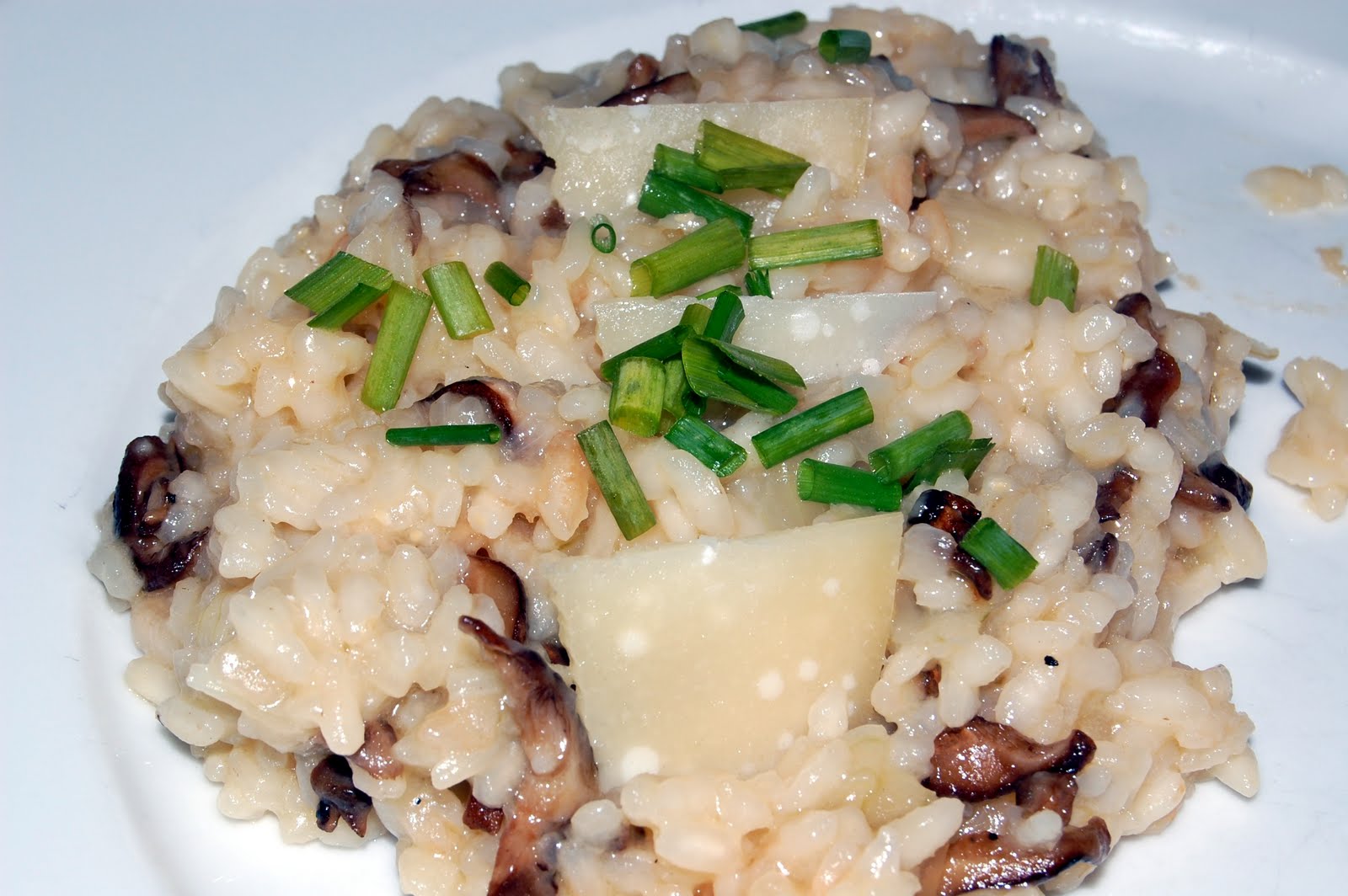
Mushroom Risotto - a Gutsy Cooks Selection
Probably like most home cooks, I was initially intimidated by the idea of making risotto. It required some kind of special weird rice, I thought, and also required practically round-the-clock stirring. Then I tried it, and realized, like most home cooks have, that it's not that difficult. You can buy the rice at any grocery store, and, although you have to stay close to the stove, you really don't have to stir every second.
I've always used Arborio rice, but I bought some Carnaroli just for fun. But I still had about a cup of arborio left, so I actually used a mixture, and can't compare.
I love the step of cooking the rice and onions together--I have no idea why.
Full disclosure: I bought a package of pre-sliced, mixed mushrooms. I must have been feeling lazy on shopping day, but I wasn't sorry that they were already sliced. Secretly, I think that buying pre-sliced anything is a sign of moral decay. As with most other signs of moral decay, it's tempting to indulge occasionally.
Pouring in the heated broth (I used chicken stock instead of vegetable broth or water). I'm sure there's a scientific reason why the broth has to be heated. I just know that it does. I also know that risotto always takes far more liquid than you think it will, so you might as well heat it up to start with. Not taking my own advice, I ended up having to heat up some water toward the end of cooking time.
And, finally, adding the sauteed mushrooms and plenty of grated Parmesan. I don't always have Parmigiano Reggiano on hand, but I did this time. I had just a little bit left after I grated it; I cut that into thin shards and placed themn on top of the risotto. The bites that had the extra Parmesan were extra good.
Served with green beans with pancetta, from my French Fridays with Dorie assignment. A very nice dinner: at one time, I had all four burners of my stove occupied. This doesn't happen very often. When it does, I fear impending doom, but no doom occurred.
TASTE-O-METER RATINGS:
Jim: I'll give this an 8 1/2. But I'd give a 10 to the bites with melting cheese.
Marie: Also an 8 1/2. Good, but it still needed a little oomph. Maybe it was just missing the wine. Maybe it just needed more salt. Garlic? Some herbs?
You can find this recipe here.
Saturday, February 19, 2011
Green Beans with Pancetta - French Fridays with Dorie
I love green beans. And the idea of cooking them until they're crisp tender, tossing them in a little butter and pancetta, and finishing them off with a drizzle of walnut oil sounded terrific. I thought it was very good, but maybe not quite terrific.
It took me more than two minutes to saute the pancetta "until frizzled and crisp." At the two-minute mark, the pancetta was still pretty limp. It's still not crisp enough for my taste in this picture, taken after about five minutes.
Beans in boiling water.
Beans in ice water. See how nice and green they are after being "shocked" by the cold water. I wish chefs would use a different word, like "refresh." I hate to shock the poor beans.
Back to the skillet, where they're reheated in a little butter, theoretically mixed with some of the pancetta fat that was rendered during the sauteeing process. My pancetta yielded only a few drops of fat. Apparently I bought pancetta Lite. This is the walnut oil I use. I keep it in the refrigerator because it otherwise goes rancid pretty quickly. It's still a good idea to give it a sniff before using it. If it's rancid, it'll only take a sniff to know it.
And there they are, ready to be served with mushroom risotto (or anything else you choose). As I said, I thought these were good, but not terrific. Even with all the good flavors, I thought something was missing. I think I'd saute a shallot with the pancetta next time. Or maybe they just needed another shake of the salt shaker. (I heard a chef say that the biggest mistake home cooks make is not salting enough--I know it's heresy to say this, but I like foods that have been properly salted.
Subscribe to:
Posts (Atom)